The challenge
I was treating pages as finished once they were published. The Bing Webmaster chart showed it: a flat line of small numbers for weeks.
The question I started asking was different: not "what did I plan this page to rank for?" but "what are people actually typing, and does my page answer it?"
What I did
- Open Search Performance and read the real queriesThe words people actually typed, not just the keywords I planned.
- Find the questions the page does not answerGaps between a query and what the page says are the quickest wins.
- Put the answer near the topIn plain words, then add detail below.
- Fix the real problem behind the searchCost, timing, rules, what to do next. The thing the person is trying to solve.
- Refresh, wait, check, repeatCheck again in a few weeks and start the loop over.
The result
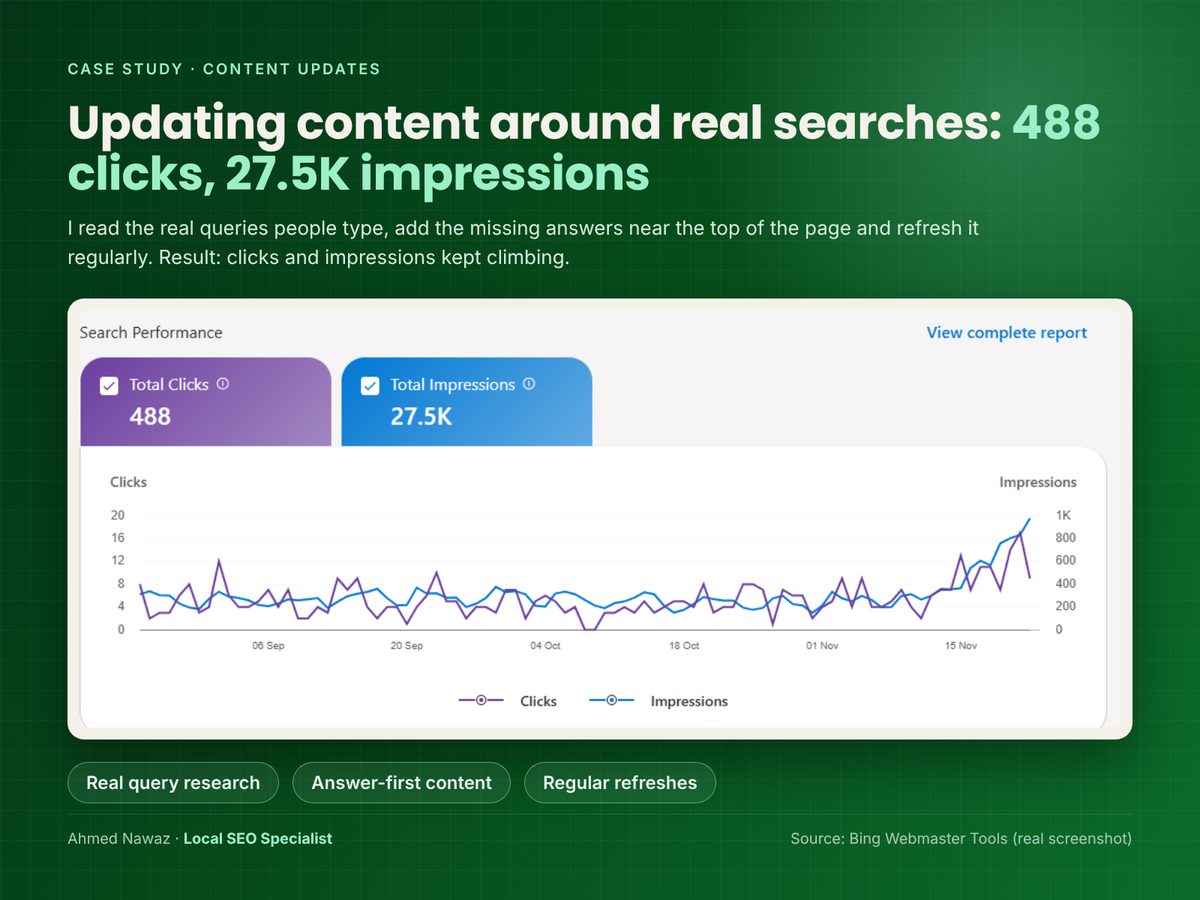
488 clicks and 27.5K impressions on this site in Bing, and the line was still going up when I took the screenshot. In the chart, the weeks before were flat, and both lines rise towards the end.
I want to be careful about the claim. I cannot say one edit caused it. Rankings move for many reasons, and I changed more than one thing on the site over those weeks.
What the numbers show
- The chart was flat while pages stayed unchanged, and climbed during the weeks I updated pages around real queries.
- Pages that answer what people ask appear to earn more visibility than pages written once and left alone.
What they do not show
- That one edit, or this routine alone, caused the climb. This is a pattern I observed, not a controlled test.
- That Bing numbers will carry over to Google. They are separate search engines and separate reports.
Lessons
- Real queries beat planned keywords. The words in Search Performance are customers telling you what they need.
- Answer first. Put the answer where a hurried reader will see it.
- Treat a page as alive. Refresh it, check, and refresh again.
- Be honest about causes. A pattern worth repeating is still not proof.