The challenge
The domain was empty: no content, no history, no authority. The goal was to rank in local search for a US city and turn that visibility into phone calls.
A local service site needs a lot of near-similar pages (sizes, services, areas), and that is exactly how sites end up with pages competing against each other. On top of that, the pay-per-call network I was aiming for has strict rules: call-only CTAs and no prices anywhere on the site.
So the brief to myself was: build many pages, let none of them overlap, and keep every one compliant.
What I did
- Map the keywords before writingOne sheet, one row per page, one focus keyword each. A keyword was checked against the map before a page was written. Titles follow one formula: primary keyword plus the customer's pain point, under 60 characters.
- Split the site into three page groups6 size pages (one per dumpster size), service pages (one per service type) and 9 service-area pages (one per area). Blog posts sit alongside, each aimed at a question people actually ask.
- Write each page for its own searchArea pages carry real local detail, and each one passes a swap test: if another city's name fits just as well, the page is not finished.
- Link the pages on purposeEvery area page links to the relevant service and size pages, so visitors and crawlers can move from the broad page to the specific one.
- Connect the schema with @idLocalBusiness is defined once with its own @id. Service schema points back to it as provider and carries areaServed. FAQPage is used only where the FAQs are visible on the page.
- Check indexing page by pageEvery page was checked with the URL Inspection API. At my last check in early November 2026, 47 of the 49 pages I was tracking were indexed.
- Protect speed and layout stabilityLiteSpeed Cache, WebP images and self-hosted fonts. One cache setting pushed CLS to 0.349; I rolled it back and re-tested on mobile. CLS is now 0.029.
- Stay inside the network's rulesCall-only CTAs and no prices. The site was approved by a pay-per-call network.
The result
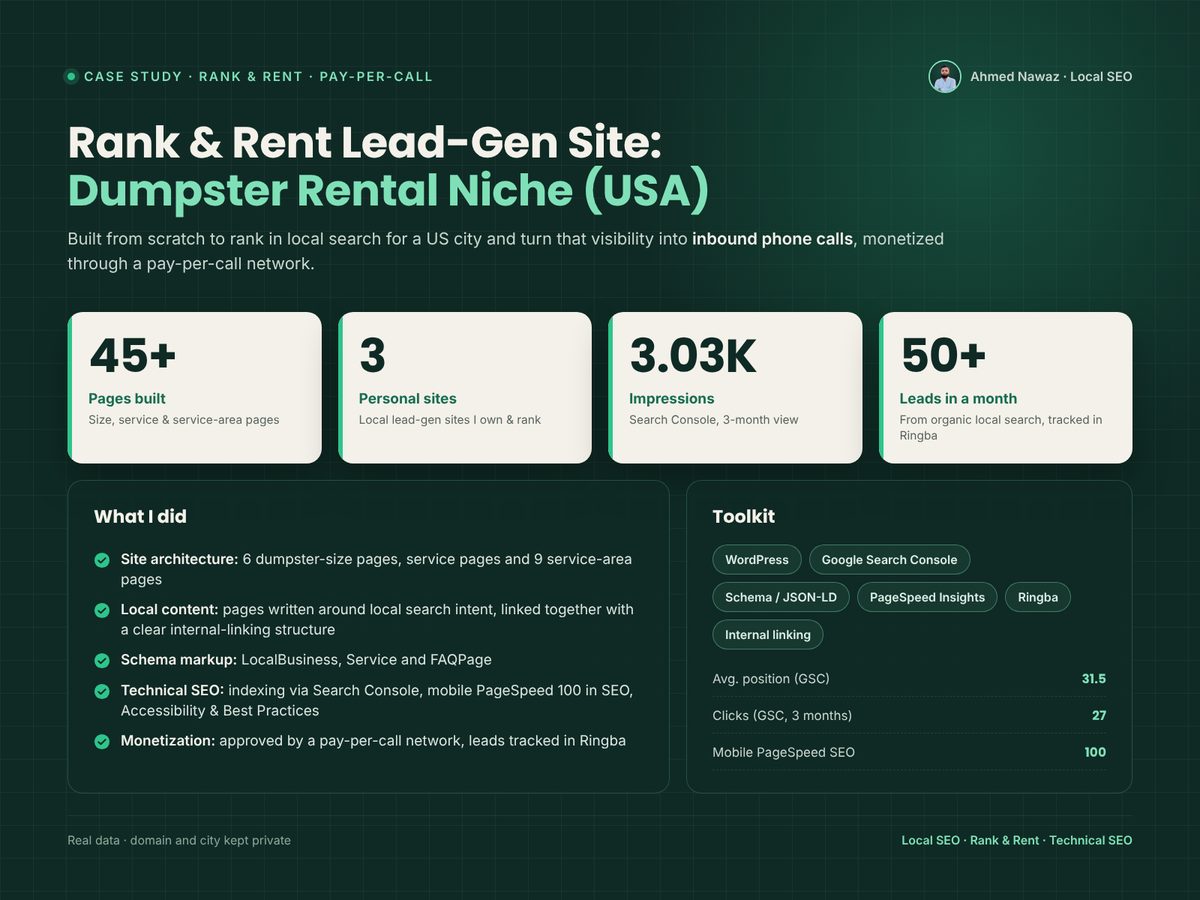
The site went from an empty domain to 45+ optimized pages, with a clean structure where each page has its own job. Technically, it reached 100 on mobile PageSpeed for SEO, Accessibility and Best Practices, every blog post scores 80+ in Rank Math, and CLS went from 0.349 to 0.029.
The site is also approved by a pay-per-call network. What that produced is covered in the Ringba case study, and what the site looked like in Google at 45 days is in the Search Console case study.
- A structure of 45+ pages can be planned so that no two pages compete.
- Connected schema, internal links and indexing checks can be built in from the start.
- Technical scores can be protected by testing one change at a time.
- That every page ranks on page one. The site is young and most pages are still climbing.
- That the same page count suits every business. The structure follows the niche and the area.
Lessons
- Plan cannibalization out, do not fix it later. A keyword map takes a few hours. Untangling competing pages takes far longer.
- Rules shape content. The network's call-only and no-prices rules changed how I wrote every page, so I read them before drafting, not after.
- Test one change at a time. A faster-feeling cache setting cost me layout stability. A rollback and a re-test found it in minutes because it was the only change.
- Indexing is a task, not an assumption. Checking each URL showed me what Google actually had.